Ox Shoes Discovery Stuns Oak Island Team — Could This Prove Medieval Explorers Reached the Island?
The Ox Shoes That Changed the Search: A Breakthrough Moment on The Curse of Oak Island
On The Curse of Oak Island, small discoveries often lead to big questions—but every so often, a single type of artifact begins to reshape the entire search. That moment arrived when a series of ox shoes, unearthed across multiple lots, suddenly transformed from routine finds into compelling evidence of a long-hidden operation on the island.
What once seemed like scattered farm relics now appears to be something far more significant: a coordinated hauling system that may connect the swamp, Lot 15, and the legendary Money Pit itself.
A Deeper Look at Samuel Ball’s Land
The breakthrough begins on Lot 26, land once owned by Samuel Ball, a former enslaved man who mysteriously became one of the wealthiest individuals in Nova Scotia during the early 19th century. For years, Ball’s sudden prosperity has fueled speculation that he knew far more about Oak Island’s secrets than history records.
Metal detection expert Gary Drayton, joined by Michael John, targets the area near Ball’s former homestead foundation. With surface artifacts already cleared, Gary brings out what he calls the “big mama jamma”—a massive 32-inch coil capable of detecting large iron targets six to seven feet deep.


This is no casual search. The land has been cleared of trees and brush, allowing Gary to run deep scans in open spaces where heavy activity may once have taken place.
Almost immediately, a strong signal emerges.
What they uncover isn’t gold—but it may be just as important.
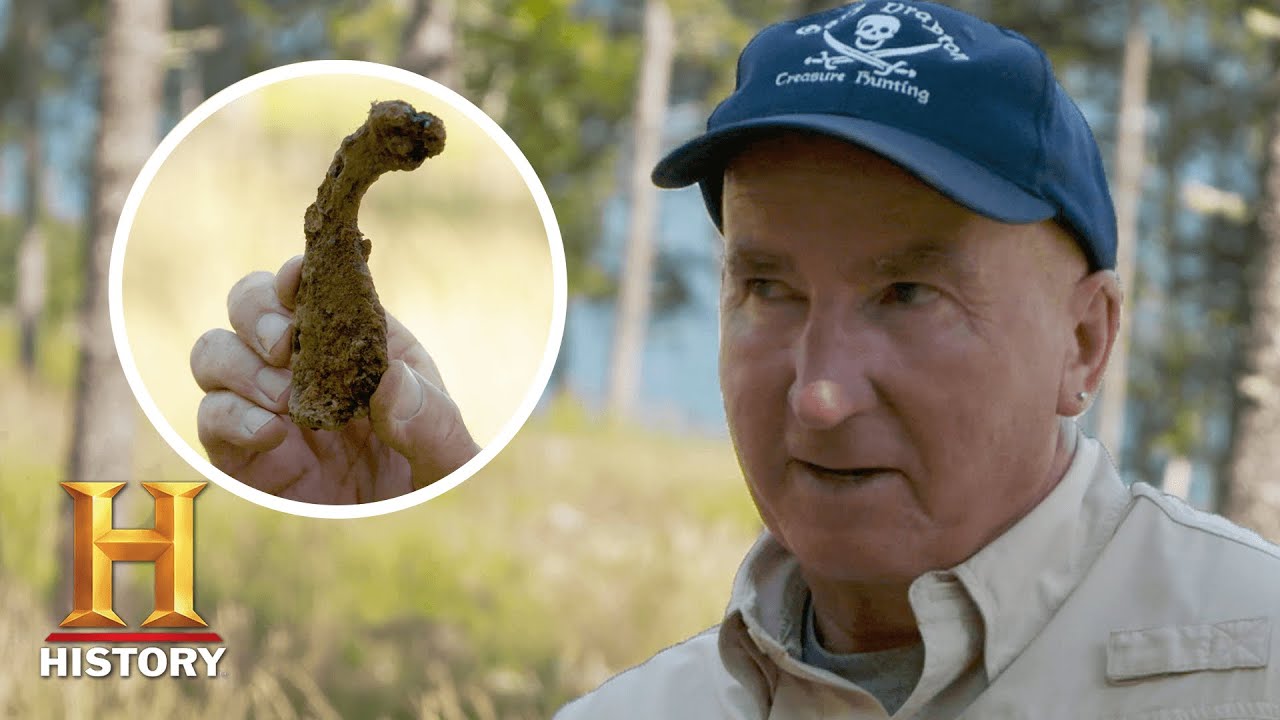
A small ox shoe, remarkably well preserved.
Gary instantly recognizes its significance. The team has already found massive ox shoes near the swamp—what Gary famously dubbed the “Shaq daddy” of ox shoes. But this one is different. Smaller. Lighter. Yet undeniably old.
And crucially, it doesn’t appear alone.
From Farm Tool to Industrial Clue
On their own, ox shoes are not rare. But context is everything.
Oxen were not casually used animals. They were essential for hauling extremely heavy loads, often over rough, improvised terrain. If oxen were present on Oak Island in large numbers, it suggests organized, labor-intensive work—not simple farming.
Gary points out that multiple ox shoes found in good condition strongly hint at some form of industrial or military-scale operation. And if oxen were hauling something, the obvious question becomes: what were they moving—and where?
To answer that, the search shifts to Lot 15.
A Trail Begins to Form on Lot 15

Rick Lagina joins Gary Drayton in the uplands of Lot 15, an area already under intense scrutiny. Just one week earlier, an iron band—likely from an old cart or wagon wheel—was found nearby on Lot 17. That artifact predated the 1795 discovery of the Money Pit and suggested a possible road or pathway once ran between the swamp and the original shaft.
Now, under stricter archaeological regulations, metal detecting must follow precise grids. Targets are flagged first, then excavated only with official permission. The process is slower—but what it reveals may be worth the delay.
Among modern trash signals, Gary hits something promising.
Another ox shoe.
This one appears older than the surrounding debris and is located dangerously close to the Money Pit area. The pattern is becoming harder to ignore. Ox shoes have now been found near the swamp, near Lot 15’s mysterious stone structure, and along what could be a continuous route between them.
As Gary puts it, “Where you find ox shoes, you could be standing on a trail.”
Expert Confirmation Raises the Stakes
To understand just how old—and how important—these ox shoes might be, Alex Lagina and Jack Begley bring several samples to blacksmithing expert Carmen Legge.
Carmen immediately notes critical details. Some of the ox shoes are winter shoes, designed for traction on frozen ground. Others differ in size and style, indicating multiple animals and prolonged use.
More importantly, Carmen identifies origins that include British, French, and German designs, with some dating back to the early 1700s—or earlier.
This is a stunning revelation.
If these ox shoes predate the Money Pit discovery by more than a century, it means heavy operations were already underway on Oak Island long before 1795.
Carmen goes even further, explaining that the presence of both summer and winter shoes suggests activity across multiple seasons, not a short-term visit. This was sustained, organized work.
Possibly military. Possibly industrial.
Possibly connected directly to the construction of the Money Pit.
Everything Lines Up

Back in the field, Gary and Jack continue detecting closer to the swamp. Another ox shoe emerges—wide, heavy, unmistakably designed for hauling weight. Then comes an even more intriguing iron object, possibly part of an ox or horse harness.
Each find aligns geographically, forming what looks increasingly like a defined track or hauling route. When plotted against aerial imagery, the line appears to run from the swamp’s stone road, past the tar kiln, through Lot 15, and toward the Money Pit.
Suddenly, discoveries from past seasons begin to connect:
-
The massive stone road in the swamp
-
The pine tar kiln believed to be British and possibly 16th-century
-
The stone structure on Lot 15
-
And now, a clear trail of ox shoes marking movement between them
What once seemed like isolated mysteries may all be part of one enormous, coordinated operation.
A Turning Point in the Search
Ox shoes were never meant to steal the spotlight. For years, they were background artifacts—interesting but inconclusive.
Now, in the right context, they may be some of the most important evidence ever found on Oak Island.
They don’t promise treasure directly. But they do something arguably more powerful: they prove intent, infrastructure, and scale.
Someone was here long ago.
Someone moved massive loads.
And someone went to extraordinary lengths to do it.
As Gary Drayton says with growing confidence, “Everything is lining up now.”
And for the Oak Island team, that realization could change the search forever.