Oak Island’s Latest Discoveries Head to the Lab for Analysis – Will Science Finally Prove the Treasure Is Real?
Oak Island’s Latest Discoveries Head to the Lab for Analysis – Will Science Finally Prove the Treasure Is Real?

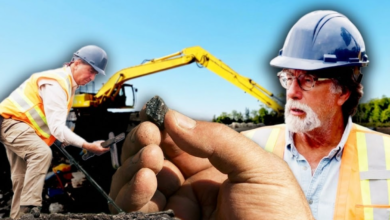
In the latest developments from The Curse of Oak Island, the long-running quest to solve one of North America’s most enduring treasure mysteries has entered a critical new phase, as scientific analysis and field excavation converge in what the team believes could be a breakthrough moment. At the center of the action is the TOT-1 shaft, a deep caisson borehole positioned in the historic Money Pit area on Oak Island, where geologist Terry Matheson and project members carefully monitor depth readings as the drill advances beyond 170 feet toward the so-called solution channel. The significance of this depth cannot be overstated. Historical records show that in 1931, Melbourne Chappell, working alongside his father William Chappell and treasure hunter Frederick Blair, sank a 157-foot shaft in a determined attempt to retrieve what they believed was a vault first identified in 1897. Surpassing that benchmark places the current team deeper than any documented previous excavation in that immediate zone. As wood fragments churn upward from the borehole, Terry notes that they are likely cutting through the remnants of the Chappell Shaft itself, an encouraging indicator that the present alignment may intersect original searcher or even depositor workings. The real anticipation, however, lies below 200 feet, where legend insists a vault containing valuables may still rest undisturbed. That anticipation intensified when Marty Lagina and metal detection expert Gary Drayton recovered a substantial iron fragment from more than 160 feet deep, a depth considered well below known searcher disturbances. The object’s weight, visible striations, and curved form suggested it might be part of a handwrought pickaxe. Notably, a similar broken pickaxe was recovered in 2019 from a nearby shaft known as RF-1, raising the possibility of a pattern.

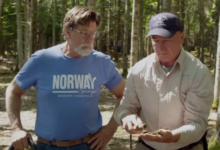
The implications extend beyond simple tool identification. During a prior investigative trip to Malta, historian Matthew Balzan had pointed out that comparable tunneling tools were used in extensive underground works associated with the Knights of Malta in the 16th century. If the Oak Island fragment proved to be of similar age, it could lend credence to theories that predate the commonly accepted 1790s discovery narrative of the Money Pit. To test that possibility, the team turned to blacksmithing expert Carmen Legge and archaeometallurgist Emma Culligan in the Oak Island laboratory. Carmen’s examination highlighted the folded grain patterns typical of repeatedly hammered wrought iron, concluding that the piece was almost certainly part of a heavy pickaxe used against stone. Crucially, he stated that tools of that particular shape and construction are most commonly associated with the 1500s, possibly extending into the early 1600s but not typical of later industrial manufacture. Emma’s compositional analysis reinforced this assessment, identifying elemental impurities consistent with iron production methods from roughly the 16th to 18th centuries. If accurate, the dating would place the tool centuries before the recorded 1795 discovery of the Money Pit and potentially align with speculative narratives involving early European or even quasi-military religious orders operating in the North Atlantic. While no definitive link to the Knights of Malta—or their predecessor, the Knights Templar—has been scientifically established, the convergence of metallurgical dating and historical context has energized the team. Rick Lagina described the artifact as potentially “the one thing that really matters,” not necessarily as treasure itself but as proof of purposeful deep excavation long before modern searchers arrived. Parallel efforts at Smith’s Cove have further demonstrated the interplay between hopeful speculation and empirical science. Gary Drayton and Alex Lagina detected a large metal anomaly buried several feet beneath shoreline rocks, prompting a coordinated excavation involving water pumps and additional manpower.



The object, once extracted, appeared to be a heavily encrusted iron conglomerate, sparking excitement that it might represent ship hardware or structural components tied to early maritime activity. However, laboratory cleaning and analysis revealed a far more prosaic explanation: the artifact was a cast-iron stove door bearing a decorative starburst design. Archaeologist Laird Niven noted that while cast-iron stoves date back to the mid-1700s, the manganese content in this particular piece suggests manufacture in the mid-1800s, likely placing it within the period of intense 19th-century searcher activity rather than an earlier depositional event. Although less sensational than hoped, the find still contributes to the layered historical narrative of Oak Island, documenting the extensive human presence associated with repeated treasure hunts. Meanwhile, excavations continue in search of the elusive flood tunnel system believed to connect Smith’s Cove to the original Money Pit. Guided by historical accounts from the Restall family’s 1961 efforts, the team has uncovered wood structures and modern nails consistent with Restall-era construction, suggesting they may have relocated the vertical shaft once filled with concrete forms that famously failed. Metal detection in the area produced additional fasteners and a broken spike, though preliminary assessment leans toward modern origin pending further testing. For Rick and Craig Tester, confirming the position of the Restall shaft is not merely an exercise in historical housekeeping; it is viewed as a potential gateway to identifying the man-made flood tunnels long theorized to protect a hidden treasure by channeling seawater into the pit. Each artifact—whether a centuries-old pickaxe fragment or a comparatively recent stove door—adds data points to an intricate archaeological puzzle. The current phase of investigation underscores a central tension that has defined the series: the balance between romantic legend and rigorous scientific validation. As drilling pushes deeper into the void beneath Oak Island and laboratory instruments scrutinize every recovered fragment, the question remains whether the accumulating evidence points toward a singular, ancient depositional event or a complex tapestry of searcher interventions layered across centuries. For now, the team presses forward with cautious optimism, convinced that depth, data, and persistence may finally illuminate the truth buried beneath generations of speculation.