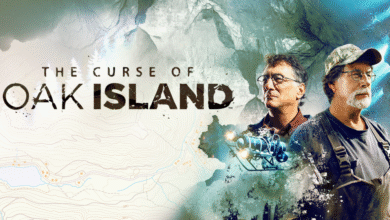
Major Breakthrough on Oak Island as Team Discovers Shipwreck Clues — Is the Legendary Treasure Actually Aboard a Hidden Ship?
HOLY SHIP! Major Discoveries Shake Oak Island as New Evidence Points to a Hidden Shipwreck

Oak Island’s mystery has taken a dramatic turn. In a week filled with unexpected finds, scientific intrigue, and underwater suspense, the Fellowship of the Dig is beginning to believe they may be closing in on the island’s most astonishing secret yet — a centuries-old ship buried beneath the swamp and possibly another wreck lying just offshore.
From the swamp’s murky depths to the tidal waters of Frog Island, the Oak Island team is uncovering one clue after another, each pointing toward a massive maritime operation that may have taken place long before the island’s modern history began.
A Massive Iron Find Sparks Excitement
Along the eastern border of the swamp, Gary Drayton and David Fernetti were back at work detecting near the mysterious stone pathway. Their equipment soon produced a promising signal — and what they unearthed stunned everyone: a huge, heavily bent iron ring bolt, likely centuries old.
“It’s an inch-and-a-quarter solid iron,” Gary noted, astonished. “Whatever bent this took enormous force.”


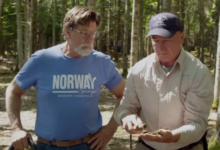
The ring bolt — similar to others found earlier in the season — may date as far back as the 17th century, supporting the theory that cargo was once offloaded onto Oak Island via the stone pathway, which many believe was a wharf or landing zone.
But a key detail took the discovery to the next level:
the object was coated in charcoal, evidence that it had been severely burned. According to Dr. Taylor, who examined the artifact, the bolt likely came from a wooden ship structure exposed to intense fire.
This revelation set off alarm bells. Days earlier, the team uncovered a charred wooden fragment believed to be part of a ship’s railing. Now, yet another scorched piece of ship-related hardware emerges from the same region of the swamp.
Target: Frog Island — A Potential Shipwreck Underwater
With mounting evidence of ship activity on Oak Island, the team turned to the newly acquired magnetometer survey results from CSR Geo Surveys. The scans revealed multiple magnetic anomalies — some adjacent to Lot 5, and one massive anomaly near Frog Island, just east of Oak Island.
Enter Dr. Lee Spence, a world-renowned underwater archaeologist credited with discovering more than 100 shipwrecks and over $50 million in historic artifacts.
After reviewing the magnetometer data, Dr. Spence gave the opinion everyone was hoping for:
“This looks like a shipwreck to me.”
With that, a dive team led by expert diver Tony Sampson prepared to investigate.

Diving Into the Unknown
The dive near Frog Island was executed with strict environmental restrictions: no digging — visual survey only.
Tony and Dr. Spence entered the water with an advanced handheld magnetometer capable of detecting iron up to 23 feet below the seabed. After battling thick kelp and silt, they soon reported exactly what everyone wanted to hear:
“We’ve got a large magnetic hit… buried under the silt.”
A second hit followed shortly after.
Despite the encouraging signals, visibility proved too poor to identify any exposed artifacts. And without visual evidence, Nova Scotia’s laws prevent the team from securing an excavation permit.
Still, Dr. Spence remained adamant:
“I’m absolutely convinced there is a shipwreck there.”
The plan now shifts toward waiting for winter storms and tidal activity to naturally uncover more of the seabed — potentially revealing enough for a future permit.
Back on Land: A Ship’s Railing Unearthed
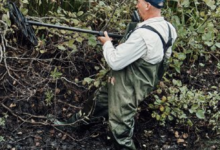
While the dive team was battling the currents, Billy Gerhardt and the swamp crew made another breakthrough. Deep within the southern swamp, they pulled up a large, beautifully finished piece of timber — with rounded edges and a square hole consistent with old shipbuilding techniques.
Gary Drayton didn’t hesitate:
“That looks like a ship’s railing.”
Even more compelling: Billy revealed that the excavator bucket kept sliding across a massive, unmovable object below this depth — something large, man-made, and definitely not natural.
The implications are staggering. Two years ago, seismic scanning detected a 200-foot-long anomaly in this very area — a shape that strongly resembled the hull of a ship.
Now, finished wood and iron fasteners from the swamp appear to confirm that theory.

A Spike From the 1700s Raises Questions
Meanwhile, Marty Lagina, Dave Blankenship, and Gary uncovered yet another important artifact: a large hand-forged ship spike, dated by archaeologist Laird Niven to the early 1700s.
The spike joins a growing list of 18th-century ship parts found across the island — in the swamp, along the stone pathway, and even in the spoils of the Money Pit area.
Every clue strengthens the possibility that Oak Island once hosted a large ship — or perhaps that a vessel was intentionally scuttled and hidden there.
Is Oak Island Finally Revealing Its Secret?
With burned iron hardware, finished ship timber, dozens of heavy spikes, and now two suspected offshore magnetic targets, the season’s discoveries are aligning more than ever before.
Rick Lagina summed up the mood succinctly:
“The swamp is a keeper of secrets. And it feels like we’re finally getting close to the answers.”
The team must now formulate a new plan — one that includes future dives, deeper swamp excavation, and tireless analysis of each clue collected.
Are they on the brink of proving that a ship — or even multiple ships — once played a key role in whatever happened on Oak Island centuries ago?
Only time, tides, and relentless digging will tell.