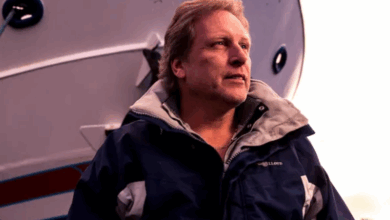
Captain Keith’s Daring Move at Sea – How Did He Save Jake Anderson’s Crew During the Titan Explorer Disaster?
Deadliest Catch: Captain Keith Colburn’s Heroic Rescue of Jake Anderson’s Crew Amid Titan Explorer Disaster
The Bering Sea, a merciless expanse of icy waters and unrelenting storms, has long been the unforgiving backdrop of Deadliest Catch. In its 21st season, the show captured one of its most harrowing and heroic moments yet—a life-or-death rescue that unfolded in real time, showcasing the raw courage and unspoken brotherhood among crab fishermen. When Captain Jake Anderson and his crew aboard the Titan Explorer faced a catastrophic ammonia leak that threatened their lives, it was Captain Keith Colburn and the crew of the Wizard who answered the call, racing against time and nature to bring them to safety.
The crisis began with a chilling distress call that pierced the airwaves in the dead of night. Aboard the Titan Explorer, a toxic ammonia leak had spiraled into a full-blown emergency. The leak, originating from the vessel’s refrigeration system, triggered a cascade of mechanical failures. Warning alarms blared as the ship’s systems shut down one by one, leaving the Titan Explorer listing dangerously to starboard. The pungent odor of ammonia filled the air, making it nearly impossible to breathe. With the vessel’s stability compromised and the risk of capsizing imminent, Captain Jake Anderson made the gut-wrenching decision to abandon ship. He and his eight crew members—each a vital part of the tight-knit team—had no choice but to pile into a life raft and cast themselves into the frigid, unforgiving waters of the Bering Sea.

The Titan Explorer was now a ghost ship, dead in the water, its radio communications failing and its lights extinguished. For Jake and his crew, the life raft offered little protection against the subzero temperatures and towering waves. Hypothermia was a looming threat, and every minute spent adrift reduced their chances of survival. The Bering Sea, known for claiming lives without hesitation, was closing in.
Aboard the Wizard, Captain Keith Colburn received the Mayday call. His vessel was the closest to the Titan Explorer’s last known position, making his crew the only hope for a timely rescue. Keith, a seasoned captain with years of experience navigating the Bering Sea’s perils, understood the stakes. “We don’t know if they’re in the water, on the raft, or still on the boat,” he said, his voice thick with urgency. “But we’re going, and we’re going now.” With no time to waste, he ordered the Wizard to full speed, pushing the vessel to its limits through the dark, turbulent waters.

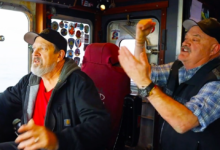
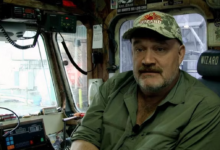
The journey to the Titan Explorer was fraught with tension. The Bering Sea’s notorious conditions—howling winds, massive swells, and near-zero visibility—tested the Wizard’s crew. Radar scans offered only faint, inconsistent blips, and the horizon remained a black void, offering no clues about the fate of Jake’s crew. The Wizard’s deckhands stood watch, their eyes straining for any sign of life—a flare, a light, a reflection. Hours ticked by, each one a gamble against the sea’s cruelty. Keith knew that even if the crew had made it to the life raft, the currents could have carried them miles away from the Titan Explorer’s last position.

After nearly four hours of searching, a breakthrough came. The Wizard’s crew spotted the eerie silhouette of the Titan Explorer emerging from the darkness. The vessel was lifeless, leaning heavily to starboard as seawater spilled from its tanks. The acrid smell of ammonia hung in the air, a stark reminder of the danger that had driven the crew to abandon ship. But there was no sign of the life raft. Keith’s heart sank as he considered the possibility that the raft had been swept away or, worse, lost to the sea.
Then, a glimmer of hope. At the 1:00 position, a faint light pierced the darkness—a signal from the life raft. The Wizard changed course immediately, every second now critical. As they closed in, the outline of the raft came into view, bobbing precariously on the waves. The scene was hauntingly still—no movement, no voices, just a zipped canopy shielding its occupants from the elements. The Wizard’s crew moved with precision, securing a line to the raft and carefully unzipping its cover. One by one, the exhausted and shaken crew members emerged. First four, then five, six, seven, eight—and finally, Captain Jake Anderson himself, pale but alive.
“Do we have everybody?” Keith demanded, his voice cutting through the wind. The headcount was confirmed: all nine souls accounted for. Relief washed over the Wizard’s crew as they provided oxygen to those affected by ammonia exposure and water to hydrate the dehydrated fishermen. Jake, visibly emotional, recounted the terrifying ordeal. “We got in the raft, tied it off, and the next thing we knew, we were drifting out to sea,” he said. “My radio died. We were just… out there.” His words underscored the razor-thin margin between survival and tragedy in the Bering Sea.
:max_bytes(150000):strip_icc()/titan-explorer-and-wizard-Deadliest-Catch-080625-9bbff2d5c76345a589ec1a77bc5048b7.jpg)
For Keith and his crew, the rescue was more than a heroic act—it was a testament to the unspoken bond that unites crab fishermen. In the Bering Sea, rivalries and competition fade when lives are on the line. Out here, the name on the wheelhouse doesn’t matter; what matters is ensuring everyone makes it home. Keith’s quick thinking, seamanship, and relentless determination turned a potential tragedy into a story of survival.
This daring rescue will be remembered as one of the most gripping moments in Deadliest Catch history. It’s a powerful reminder of the dangers faced by those who brave the Bering Sea, where every trip could be their last. The sea rarely offers second chances, but on this night, thanks to Captain Keith Colburn and the Wizard crew, Jake Anderson and his men got theirs. Their survival is a testament to the courage, skill, and brotherhood that define the crab fishing community, proving that even in the world’s most dangerous workplace, humanity prevails.