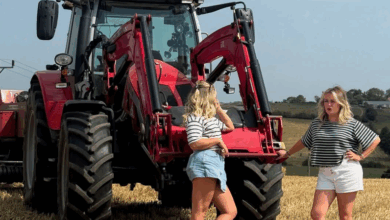
Kaleb Voices Concerns About Clarkson’s Latest Farm Technology – Could the Driverless Tractor Cause Problems?
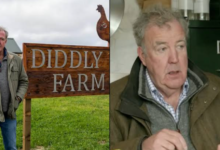
Jeremy Clarkson’s Driverless Tractor Sparks Concerns at Diddly Squat Farm
In the rolling hills of Oxfordshire, Jeremy Clarkson’s Diddly Squat Farm has become a focal point for agricultural innovation and television entertainment alike. The 65-year-old former Top Gear and Grand Tour host, who purchased the Chadlington-based farm in 2008, has captivated audiences with his Prime Video series Clarkson’s Farm. Now in its fourth season, the show chronicles Clarkson’s often humorous struggles and triumphs as a novice farmer. However, his latest venture—a £300,000 autonomous AgBot T2 tractor—has introduced a new dynamic to the farm, stirring both excitement and apprehension, particularly for his co-star and farm manager, Kaleb Cooper.
Clarkson, never one to shy away from bold moves, recently detailed his acquisition of the AgBot T2 in a column for The Times. The state-of-the-art, nine-tonne driverless tractor, built with German engineering in the Netherlands, represents a significant leap forward in farming technology. Unlike traditional tractors, the AgBot T2 operates autonomously, using a 156-horsepower diesel engine to power a generator that drives its tracks. This design allows it to maneuver with precision, turning within its own length and causing less soil damage than wheeled counterparts. Guided by American and EU satellites, the tractor can position itself within 2.5cm of its target, eliminating human errors such as missed patches or improper turns. Clarkson, who dubbed it “the coolest machine in the world,” sees it as a game-changer for the labor-intensive tasks at Diddly Squat.

For Clarkson, the AgBot T2 addresses the monotony and inefficiency of traditional farming. He described the grueling process of preparing and planting 200 acres for crops like pasta and lager, which typically takes 30 hours of tedious work. “I’m still not very good at it,” he admitted. “I miss bits. I cock up turns and corners. I hit gateposts, and most years I bounce along for hours, not realizing that the hopper is empty and I’m busy planting nothing at all.” The autonomous tractor, which never tires or needs breaks, promises to streamline these tasks. Clarkson even humorously noted that he can now monitor the tractor’s progress from bed via its camera feed, or enjoy a glass of champagne at the Cheltenham Gold Cup while the AgBot drills his fields with unmatched accuracy.
The tractor’s capabilities extend beyond mere automation. Before its deployment, a Dutch expert mapped Diddly Squat’s soil, revealing underground variations in quality. This data was fed into the AgBot’s drill, enabling it to adjust seed distribution based on soil fertility—planting more seeds in rich areas and fewer in poorer ones. Clarkson believes this precision could revolutionize yields, though he cautioned that results won’t be clear until the harvest, and even then, factors like weather could skew outcomes. “It’ll probably be ten years before we really know,” he wrote, adding a tongue-in-cheek prediction that by then, “Rachel Reeves will be the new owner of Diddly Squat, and it’ll be full of houses and wind turbines.”

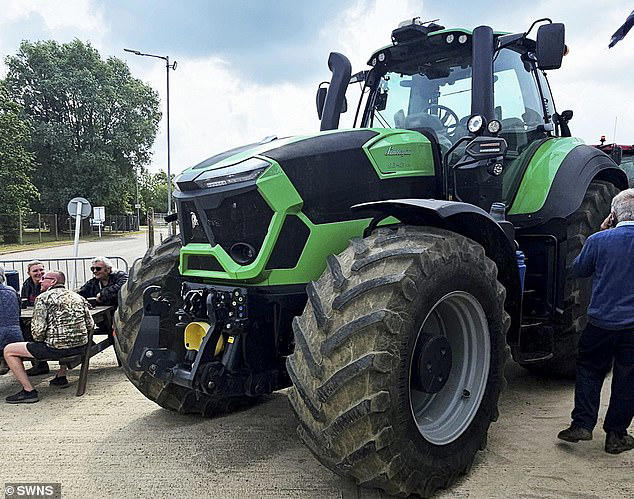
While Clarkson is enthusiastic about the AgBot’s potential, Kaleb Cooper, the 26-year-old farm manager and breakout star of Clarkson’s Farm, is far less enamored. Cooper, who worked on the Chipping Norton estate before Clarkson’s ownership, fears that the driverless tractor could render his skills obsolete. “Kaleb hates it. He says it’ll put him out of a job,” Clarkson revealed. This concern is not unfounded, as automation in agriculture has historically reduced the need for manual labor. Cooper’s frustration was compounded when he had to spread rhino and giraffe dung from Cotswold Wildlife Park to prepare fields for the AgBot, only to find the machine relentless in its pace. “He was literally being hounded by a machine that absolutely will not stop,” Clarkson noted, highlighting the tractor’s tireless operation compared to human limitations like the need for sleep.
Clarkson, ever the pragmatist, tried to assuage Cooper’s fears by suggesting a silver lining. He pointed out that if Cooper’s contracting business adopted an AgBot, he could set it to work on one farm and operate a traditional tractor elsewhere, effectively “double dipping” on income. While Cooper acknowledged the logic, his unease persisted, reflecting a broader tension between technological progress and job security in farming. Social media discussions on platforms like Reddit reveal a divided audience: some fans praise the AgBot as “insanely impressive” and a tool that could free up farmers like Cooper for higher-value tasks, while others warn that it “kills jobs like Kaleb’s” by reducing the need for skilled contractors.

The introduction of the AgBot T2 has also sparked mixed reactions beyond the farm. Some Cotswolds locals, already grappling with the influx of tourists drawn by Clarkson’s Farm, worry that the autonomous tractor diminishes the “romance” of traditional farming. Clarkson countered this sentiment by comparing the AgBot to the tractors that replaced horses in the 1920s, arguing that progress is inevitable. “You’ve got to move on,” he wrote, likening resistance to the AgBot to nostalgia for outdated red phone boxes. Nevertheless, the tractor’s arrival has added fuel to ongoing debates about development in the area, with some residents citing Clarkson’s fame as a factor in proposed projects like Rainier Developments’ 350-home plan.
As Diddly Squat Farm embraces cutting-edge technology, the AgBot T2 represents both a leap toward efficiency and a challenge to traditional farming roles. For Clarkson, it’s a chance to reclaim time and improve productivity; for Cooper, it’s a looming threat to his livelihood. As the farming world watches this experiment unfold, the true impact of the driverless tractor—on yields, jobs, and the Cotswolds’ rural charm—remains to be seen.