Policy, Market, and Weather Form a Fatal Trap for UK Agriculture — Is There Any Way Out for British Farmers?
British Agriculture Is Trapped in a “Triangle of Death”: Policy, Market, and Weather

British farmers are not afraid of hard work. They are used to long days, thin margins, and unpredictable outcomes. What they increasingly fear is something far more dangerous: a system that makes survival impossible no matter how hard they try.
In recent years, UK agriculture has become trapped inside what many farmers now describe — explicitly or not — as a triangle of death: government policy, market forces, and uncontrollable environmental pressure. Each side of the triangle tightens the space farmers have to operate. Together, they form a trap with no obvious exit.
Clarkson’s Farm did not create this crisis. But by accident, it has exposed it.
Policy: Regulated Like Corporations, Treated Like Individuals
The first corner of the triangle is policy — and since Brexit, it has become sharper.
For decades, British farmers relied on EU subsidies not as profit, but as stabilization. The payments compensated for volatile weather, price swings, and long production cycles. When those subsidies were cut and replaced with new UK schemes, farmers were promised a fairer, greener system.
What they got instead was uncertainty.
Environmental land management programs arrived slowly, paid inconsistently, and demanded compliance with rules that many small farms simply could not afford to meet. At the same time, regulatory oversight increased. Farmers found themselves buried in paperwork, inspections, and licensing requirements that resembled corporate compliance — without corporate resources.
On Clarkson’s Farm, Jeremy Clarkson repeatedly clashes with planning authorities while trying to open a farm shop, process meat, or diversify income. His complaints often sound theatrical. But off-camera, thousands of farmers echo the same frustration.
They are regulated like large businesses, yet live like small households.
Delays in permits can mean missing an entire season. One rejected application can erase a year’s income. And appealing decisions requires time, money, and legal knowledge most farmers simply don’t have.
Market: Food Is Everywhere, Profit Is Nowhere
The second corner of the triangle is the market — and this is where the system feels most cruel.
British supermarkets are full. Shelves overflow with meat, dairy, vegetables, and grains. To the consumer, the food system appears healthy.
To the farmer, it is suffocating.
Large retailers dictate prices, often paying farmers less than the cost of production. Contracts are rigid. Negotiation is minimal. When costs rise — fuel, feed, fertilizer, labor — farmers absorb the loss. When prices fall, they absorb that too.
The paradox is brutal: farmers lose money even when their products sell out.
On Clarkson’s Farm, Clarkson’s decision to open the Diddly Squat Farm Shop is more than a business experiment. It is an act of rebellion. By selling directly to consumers, he bypasses supermarkets, processors, and distributors — and suddenly, the farm becomes viable.
But this solution is not scalable.
Not every farmer has a TV audience. Not every village supports a direct-to-consumer model. And many are legally restricted from selling or processing their own products due to zoning or licensing rules.
The profit remains trapped in the middle — logistics, processing, retail — while the people who grow the food fight over scraps.
Weather and Disease: No Margin for Error
The third corner of the triangle is the most unforgiving: nature.
British farming has always been shaped by weather. But climate instability has turned risk into routine. Droughts arrive without warning. Rain falls at the wrong time. Crops fail not because of poor management, but because the season simply breaks.
Add to that livestock disease outbreaks — avian flu, bovine TB, swine fever — and the consequences are devastating. Mandatory culls, movement restrictions, and biosecurity rules can wipe out herds overnight.
For large agribusinesses, these losses are painful but survivable. For small and medium farms, they are often terminal.
There is rarely a “Plan B.” No emergency capital. No pause button.
A single bad season can end generations of farming history.
Why Clarkson’s Experience Matters
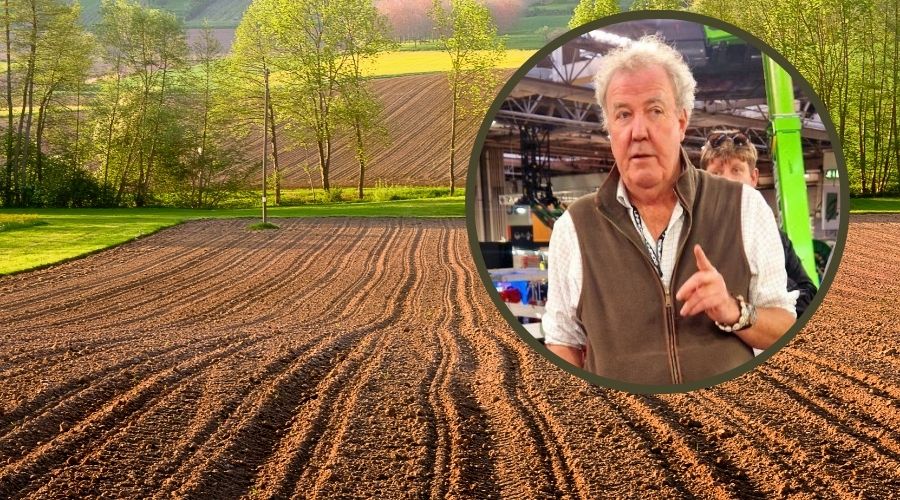
Jeremy Clarkson did not set out to become a spokesperson for British farmers. He often insists he just wanted to farm.
That is precisely why his experience matters.
Clarkson enters agriculture with advantages most farmers will never have: wealth, influence, media attention, and access to decision-makers. And yet, even he struggles to navigate the system.
If someone with those advantages finds the triangle suffocating, the implication is unavoidable.
For ordinary farmers, the walls are already closing in.
A System Farmers Can’t Escape
British farmers do not ask for sympathy. They ask for fairness.
They are willing to work through bad weather. They accept physical labor and financial risk. What they cannot survive is a system where:
-
Policy punishes flexibility
-
Markets reward everyone except producers
-
Nature offers no second chances
The crisis facing British agriculture is not about laziness or inefficiency. It is about structural failure.
As one unspoken truth becomes clearer with each season of Clarkson’s Farm, the message is simple — and alarming:
British farmers don’t fear hard work. They fear a system that doesn’t allow them to survive.
If you want, I can:
-
Turn this into a documentary narration script
-
Sharpen it into a hard-hitting investigative exposé
-
Or localize it further with real farmer quotes and statistics
Just tell me how sharp you want the blade.