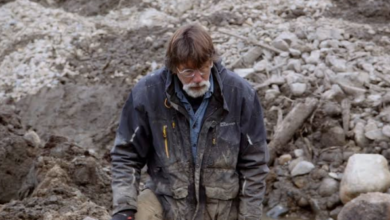
Oak Island Team Finds Wool Hidden Under Boulder on Lot 8 – Could This Be the Clue They’ve Been Missing?
Why Was Wool Buried Beneath This Boulder? Oak Island’s Lot 8 Discovery Turns Stranger Than Ever

A bright morning on Oak Island should feel calm. But on The Curse of Oak Island, calm never lasts long—especially when the team is standing over a massive boulder that looks less like a random rock and more like something placed with purpose.
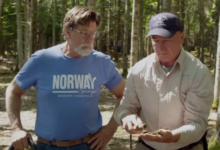
In Season 13, Rick and Marty Lagina, along with Craig Tester and the rest of the crew, return to Lot 8 to continue investigating a discovery that’s quickly becoming one of the most unsettling mysteries of the season: a giant boulder sitting on top of smaller, evenly spaced stones, arranged in a way that strongly suggests it was not formed by nature.
And just when the team thinks they’ve seen it all… they uncover something no one expected.
Wool. Buried beneath the boulder.


Not dirt. Not moss. Not animal nesting.
Wool—dyed fabric—hidden under stone like it was left there on purpose.
A Boulder That Doesn’t Behave Like a Boulder
From the moment the team gathers on Lot 8, the boulder feels wrong. Not because it’s big—Oak Island is full of big rocks—but because of what lies beneath it.
The archaeologists have excavated a trench that runs well below the bottom of the boulder, and the trench was packed with rubble. That detail alone changes everything.
Because rubble doesn’t fill itself.
Someone dug here. Someone filled it back in.
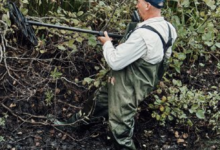
Even more chilling: the team discovers voids underneath the rock, empty spaces that appear to have been deliberately created. A snake camera pushed into one of the gaps reveals what looks like metal, possibly an iron spike… and even something that makes Rick Lagina freeze in place.
A glint.
A shine.
A shape that almost looks like a pearl.
Rick’s reaction says it all:
“Oh, my God. That looks like there’s a pearl.”
If it’s not treasure, it’s at least something that looks like treasure—exactly the kind of visual Oak Island fans know can change the entire direction of a season.
“This Was a Huge Effort for Somebody to Do This”

The deeper the team looks, the more it becomes obvious this isn’t random geology. Jack Begley says what everyone is thinking:
“This was a huge effort for somebody to do this. We just don’t know when, why, and who.”
That’s the haunting part. The work required to dig under a massive rock—without modern equipment—would have taken serious manpower, planning, and time.
Then comes the bigger theory.
Archaeologist Ian Spooner suggests the trench is not just evidence of digging, but evidence of intent.
Someone wasn’t simply searching.
Someone was trying to get under the boulder.
And Marty Lagina takes it one step further.
What if this boulder isn’t an obstacle?
What if it’s a plug?
A seal.
A deliberate cover designed to hide something that was never meant to be found.
Rick agrees immediately.
“I think it is covering something… some sort of cavity where something was placed.”
In Oak Island language, that’s the most dangerous sentence of all.
Because if it’s a plug, it means somebody successfully hid something… and walked away believing it would stay hidden forever.
Marty Brings In Heavy Machinery—But Carefully
The team reaches a limit. There are multiple large stones blocking access. They can’t safely continue digging by hand with these boulders looming over the trench.
Marty decides it’s time.
They need an excavator.
But even as he operates the machine, Marty stays cautious. One wrong move and the boulders could shift, collapse, and destroy the very evidence they’re trying to protect.
This isn’t just excavation anymore.
It’s surgery.
Slow, controlled, and tense.
And then—just as one large stone is removed—Craig Tester notices something strange.
Something red.
Something shredded.
Something that definitely doesn’t belong under a rock.
The Shocking Find: A Piece of Dyed Textile

Craig holds up what looks like a clump of decayed material. It’s not wood. Not roots. Not rope.
It looks like fabric.
Laird Niven examines it closely and confirms the suspicion.
The red section appears to be cloth, possibly dyed.
And it’s not sitting on the surface.
It was under one of the boulders, buried around 18 inches deep.
That detail matters.
Because it means this fabric was trapped there long before modern visitors ever set foot on Lot 8.
Craig immediately begins imagining a simple explanation—maybe someone scraped their jacket while moving stones, leaving behind a piece of clothing.
But Laird isn’t satisfied with “maybe.”
If the fabric is old, it could become one of the most valuable dating clues they’ve found in weeks.
Even Craig jokes that if a mouse buried it, it still proves something important:
If the fabric got there after the rock structure was built, it would still be younger than the structure—meaning it could help date the construction timeline.
Either way, it’s a clue.
And on Oak Island, a clue is never just a clue.
It’s a door.
The Lab Results: CT Scan, XRF… and a Burn Test
The team takes the textile to the lab, where Emma Culligan runs it through serious analysis—CT scanning, XRF, and detailed imaging.
The CT scan reveals something surprisingly clear: the fabric has a visible pattern of loops.
It’s weft knitting, a style created by interlocking rows of loops.
That alone raises new questions.
Was it handmade?
Was it early machine-made?
Emma can’t confirm from visuals alone, but she knows one thing: the material itself can be identified quickly.
And that’s when she suggests a method that feels almost too simple for such a mysterious artifact.
A burn test.
The team watches closely as the textile is set on fire for just a moment.
Emma explains what each material would do—polyester melting, cotton turning to ash, silk snuffing out quickly.
But when the fabric burns and cools, it clumps in a very specific way.
Emma crushes it between her fingers.
And delivers the answer:
It’s wool.

The room reacts instantly.
Marty looks stunned.
Laird’s mind races.
Because wool isn’t just wool.
Not here.
Not under a boulder.
Not on Oak Island.
The Leeds Connection: A Bag Seal and a Sheep Symbol
Then comes the detail that makes the discovery explode in importance.
Not far from where the wool was found, another team member previously uncovered a bag seal—a historic trade artifact.
And that seal carries a sheepskin symbol tied to Leeds, England, a city famous for wool manufacturing dating back to the 1300s.
Suddenly, the wool isn’t just a random scrap.
It becomes a possible link to trade, shipping, and human activity centuries ago.
And if that connection holds…
Then Lot 8 might not be a side story anymore.
It might be the center of something much bigger.
So Why Was Wool Buried Beneath the Boulder?
That’s the question no one can answer yet.
Was it part of a worker’s clothing?
A piece of cargo?
A marker?
A deliberate offering?
Or a clue left behind by someone who wanted future searchers to look in the wrong direction?
Emma says the next step is bringing in experts—people who can analyze knitting patterns, dye recipes, and fiber age more precisely.
But Rick Lagina doesn’t want to wait too long.
Because now the team has something they didn’t have before:
Proof that humans were here.
Proof that they worked under this rock.
And proof that whatever lies beneath the boulder might be more than just empty space.
As Rick puts it, the only way forward is clear:
They have to dig deeper.
Carefully.
Slowly.
And under full archaeological control.
Because if the boulder is truly a plug…
Then the moment they break through it could reveal something Oak Island has been hiding for centuries.
And if they’re wrong?
They may never get a second chance.