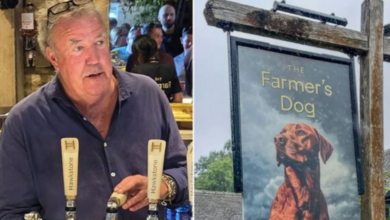
Clarkson’s Farm Reveals Deep Truths About Modern Agriculture – What Does Jeremy’s Struggle Say About Britain’s Farming Crisis?
The Political Economy of Clarkson’s Farm: Why Jeremy Clarkson’s Fields Tell a Bigger Story Than Politics Ever Could

At first glance, Clarkson’s Farm looks like light entertainment: an irreverent TV presenter blundering his way through agriculture, arguing with bureaucrats, battling the weather, and relying heavily on his long-suffering farm manager, Kaleb Cooper. But beneath the comedy, frustration, and spectacle lies something far more revealing. As Stuart Watkins argues, Clarkson’s Farm has become one of the most unexpectedly insightful portrayals of political and economic life on modern television.
In fact, the show works almost perfectly as a political parable—one that exposes how detached many popular assumptions about wealth, land ownership, and profit really are.
The Myth of Easy Money
A common belief on the political left is that wealth flows effortlessly to those lucky enough to inherit land or capital. If you own assets, the thinking goes, all that remains is to hire labor, exploit it ruthlessly, and watch the money roll in. Farming, in this worldview, should be especially lucrative for someone like Jeremy Clarkson: wealthy, well-connected, and in possession of vast acreage.
Ironically, Clarkson himself appears to begin the show holding a version of this assumption—minus the moral condemnation. His approach, at least initially, is simple. He has the land. He has the money to invest in equipment and labor. How hard can it be? Do some “tractoring,” follow the instructions, and enjoy the profits.
Reality, however, arrives swiftly and brutally.
At the end of his first year running Diddly Squat Farm, after endless labor, stress, and mishaps, Clarkson calculates his profit: £144. Not £144,000. Just £144—an amount laughably small compared to the investment required to even begin the next farming cycle.
That single figure demolishes a powerful myth.
Why Farming Survives at All
![Sun Column] Jeremy Clarkson: “The Government is out to destroy farmers & won't let us fight… I'm convinced it's part of PM & Reeves' sinister plan” 🚜 : r/thegrandtour](https://external-preview.redd.it/sun-column-jeremy-clarkson-the-government-is-out-to-destroy-v0-iNnNPqKc0EuiW0PxhSYx2YG4bXoQqHgD2sn25QVAXRk.jpg?auto=webp&s=65de3cc79ac73a3797dfd686dc824f7bba973037)
What Clarkson’s Farm makes painfully clear is not how easy farming is, but how astonishing it is that it survives at all. Clarkson’s experience exposes the sheer volume of obstacles farmers face daily: unpredictable weather, complex and often absurd regulations, intrusive bureaucracy, rising costs, falling prices, volatile markets, expensive technology, environmental levies, and relentless paperwork just to prove compliance.
Add to that global shocks—a pandemic, war, broken supply chains—and the question shifts. It is no longer “Why do farmers complain?” but “How does anyone manage to keep producing food under these conditions?”
Yet somehow, farmers persist. Despite appalling pay, minimal returns, and staggering uncertainty, food still appears on supermarket shelves. This, Watkins argues, is nothing short of a miracle—and one rooted in entrepreneurship.
The Forgotten Role of the Entrepreneur
At its core, farming is entrepreneurial work in its purest form. Farmers make massive upfront investments for returns that may or may not arrive months—or years—later. They commit resources under conditions of deep uncertainty, knowing that weather, prices, or policy changes could wipe out their efforts overnight.
When it works, the rewards can be substantial. When it doesn’t, failure is swift and often invisible. Society tends to notice only the successful entrepreneurs—and criticize them relentlessly—while ignoring the many who quietly collapse under the pressure of bad luck or bad timing.
Clarkson’s Farm makes this reality visible. Clarkson can afford mistakes that would ruin others. Even so, the show demonstrates just how narrow the margin for survival really is.
The Pub as Economic Miracle
Watkins highlights another revealing example from the show’s later seasons: the country pub. Many viewers will recognize the familiar disappointment—an aging building, stale beer, indifferent service, and food best forgotten. The natural response is to complain.
But after watching Clarkson’s Farm, a different perspective emerges. Instead of asking why the pub is bad, one begins to wonder how it exists at all.
Running a rural pub involves many of the same pressures as farming: rising costs, shrinking margins, regulation, staffing challenges, and unpredictable demand. Profit is fragile. Failure is common. Survival itself becomes a minor miracle.
Clarkson’s attempt to revive and operate a pub reveals how easily such businesses can slide into decline—and how much effort is required just to keep the lights on. That shabby pub down the road? It may not be a sign of laziness or incompetence, but of an economic system that makes success increasingly rare.
A Lesson Without a Lecture
What makes Clarkson’s Farm so powerful is that it delivers these insights without preaching. There are no lectures on free markets or state intervention, no ideological manifestos. Instead, viewers watch reality unfold: decisions made, risks taken, rules followed, and consequences endured.
The show quietly undermines simplistic political narratives from both left and right. It challenges the idea that ownership guarantees profit, while also questioning the belief that regulation and bureaucracy are cost-free or harmless. It reveals that wealth creation is neither automatic nor immoral—but fragile, risky, and hard-won.
More Than Entertainment
In the end, Clarkson’s Farm succeeds not just as comedy or reality television, but as a window into economic truth. It shows what political theory often obscures: that markets are lived experiences, that entrepreneurship involves sacrifice, and that survival itself can be an achievement.
The next time Clarkson argues with a council official or stares in disbelief at a balance sheet, viewers may find themselves seeing more than a celebrity out of his depth. They may be watching one of the clearest illustrations of political economy currently on television—played out not in lecture halls or parliaments, but in muddy fields and struggling businesses across the countryside.