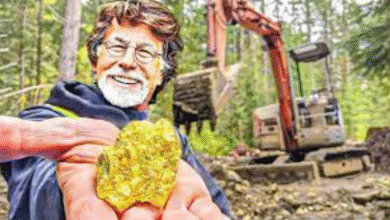
Oak Island Season 13 Uncovers a Folded Coin That Changes Everything. What New Questions Does It Raise?
Evidence That Raises New Questions: The Folded Coin That Deepens Oak Island’s Mystery (Season 13)

Season 13 of The Curse of Oak Island has delivered no shortage of intrigue, but few discoveries have sparked as much debate—and quiet fascination—as a small, carefully folded copper artifact recovered from the spoil piles of Lot 5. At first glance, it appeared unremarkable. Yet as experts weighed in, the object began to suggest something far more complex: intention, belief, and possibly a connection to centuries-old rituals that refuse to stay buried.
The discovery began when metal-detection expert Gary Drayton completed a full scan of the Lot 5 spoil piles. Among the debris removed from a mysterious round feature, one item stood out—a tightly folded piece of copper, initially thought to be a coin or token. When Rick Lagina and members of the team brought the artifact to the lab for analysis with Laird Niven and archaeometallurgist Emma Culligan, excitement was tempered by uncertainty.
At first, CT scans offered no definitive reliefs or markings that could conclusively identify it as a coin. The folds obscured any clear imagery. Still, the way it had been folded—neatly and deliberately—raised immediate questions. This was no accident of machinery or natural compression. Someone, long ago, had taken time and care to shape this object.
Gary Drayton was quick to draw on his experience in England, where he had encountered similar finds while metal detecting. Folded coins, he explained, were often talismans—objects imbued with symbolic or spiritual meaning. In medieval and post-medieval Europe, people folded coins and prayed to saints, asking for protection or miracles. The coin’s value, even if modest, gave weight to the prayer. Sacrifice mattered.


Emma Culligan’s metallurgical analysis added a crucial layer. The artifact was made of a copper alloy containing zinc, arsenic, and lead. That composition placed it firmly in the post-medieval period, likely before the mid-1800s. The presence of arsenic suggested it could date as far back as the late 1600s, potentially earlier. In other words, the object aligned closely with the time frame of many other Oak Island finds—buttons, trade beads, and artifacts that have long fueled speculation about European visitors centuries before official settlement.

What truly intrigued the team was the triple fold. While folded coins are known in history, folding a coin three times is considered unusual. Why three? Was it symbolic? Religious? Cultural? Research has yet to provide a definitive answer, but the number itself invites interpretation. In Christian traditions, three often carries spiritual significance. Whether coincidence or intention, the precision of the folds suggests purpose rather than improvisation.
The conversation turned naturally to sailors. Oak Island, after all, sits along historic transatlantic routes. Seafaring in the 1600s was perilous, and superstition was common. Sailors often carried charms to ward off evil or misfortune before long voyages. A folded coin, prepared in Europe and brought across the ocean, would fit that narrative all too well.
Still, the mystery deepened when the team consulted coin expert Sandy Campbell. Upon examination, Campbell concluded that the object was indeed a coin, folded three times as part of a ritual practice dating back centuries. He explained that folded coins were believed to trap evil within the metal. Once folded, the coin could be buried or discarded, neutralizing the threat. The ritual, Campbell noted, had roots stretching back to early medieval times and was associated with Christianity, the Crusades, and even the Knights Templar.
Because of its size and material, Campbell ruled out a medieval origin, instead placing the coin in the 1600s or early 1700s. Importantly, he emphasized that copper—not silver or gold—was typically used for such rituals. Copper represented both wealth and strength, making it suitable for spiritual offerings without excessive sacrifice.
This is where Oak Island’s long-running theories resurfaced. The time frame, symbolism, and religious undertones led Rick Lagina to raise a familiar but provocative name: the Knights of Malta. Historically linked to the Knights Templar through shared traditions and noble families, the Knights of Malta have long been considered possible players in Oak Island’s past. The idea that this folded coin could relate—however indirectly—to those orders adds another layer to an already dense puzzle.

Further intrigue emerged when the orientation of the Lot 5 feature was discussed. Its east–west alignment mirrors that of known Templar-associated churches and structures in Europe. Alone, such alignment proves nothing. But combined with the coin, the buttons, the beads, and the dating, it contributes to what the team cautiously describes as a “body of evidence.”
No one is claiming certainty. The folded coin is a single artifact, a fragment of a much larger story still buried beneath layers of soil and speculation. It cannot be unfolded without destroying it, leaving its inner markings—if any—forever hidden. Yet perhaps that, too, is fitting. If the purpose was to trap something inside, opening it might defeat the ritual entirely.
As work continues on Lot 5, the team hopes more artifacts will surface, offering context and clarity. Until then, the folded coin stands as one of Oak Island’s most evocative finds—not because it answers questions, but because it raises so many new ones.
With each discovery, the mystery grows more intricate. And as puzzle pieces slowly accumulate, one can’t help but wonder: when the picture finally comes into focus, will it confirm long-held theories—or reveal a story no one ever expected?