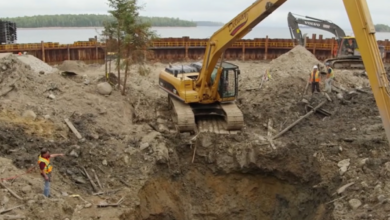
Oak Island S13E5 “Keep On Rockin'” Teases Major Discovery – Is This the 500-Year-Old Breakthrough Fans Have Waited For?
The Curse of Oak Island Season 13 Episode 5 “Keep On Rockin’”: Are We Witnessing a 500-Year-Old Breakthrough?
After thirteen seasons of mud, mystery, and maddening dead ends, The Curse of Oak Island has trained viewers to temper expectations. The island rarely reveals anything without a fight, and the Lagina brothers have spent more than a decade trying to decode a puzzle spanning centuries. But every so often, the team uncovers evidence so compelling that it forces a reevaluation of everything we thought we knew. Episode 5 of Season 13, Keep On Rockin’, appears to be one of those pivotal moments.
Based on the official episode description and the electrifying “next time” preview, the team may finally have stumbled onto something dramatic—something that does not just hint at early activity on Oak Island but establishes it with hard science. A 500-year-old artifact in the swamp, a new man-made stone structure on Lot 5, and what looks like a 16th-century hand cannon fragment all converge into one stunning question:
What the hell is going on?
A 500-Year-Old Shock in the Swamp
For years, the triangular swamp has served as Oak Island’s enigmatic wildcard. Is it natural? Is it engineered? Was it once a harbor? In Keep On Rockin’, the team finally seems to be closing in on an answer—and it’s far older than anyone expected.



The episode description explicitly states:
“After a find in the swamp proves to be at least 500 years old…”
Five hundred years. That puts the artifact at around 1525—long before the Money Pit was discovered in 1795, before Samuel Ball acquired land on the island in the late 1700s, and even before privateering was widespread in the region.
A date from the early 1500s immediately invokes the era of:
-
Spanish conquistadors
-
Portuguese explorers, including the Corte-Real brothers
-
Early French expeditions along the Atlantic coast
If the team recovered timber or organic material from the swamp and carbon-dated it to the 1520s, it implies organized European activity on Oak Island nearly 300 years before the Money Pit story began.
This directly contradicts theories that the swamp was a later agricultural or fishing feature. Instead, it suggests the swamp may once have been:
-
A covert harbor for a Spanish or Portuguese ship
-
A staging area for treasure transfer
-
A deliberately engineered hiding place
In other words, the swamp was not merely formed—it was used.
Lot 5: The Dark Horse Location Producing Architecture
While the swamp offers biological evidence of early activity, Lot 5 is now delivering unmistakable architectural proof.
The episode description notes the team uncovers another man-made stone structure. And in the preview, a crew member says:
“We’ve got the stone structure here… somebody piled those stones.”
The significance is enormous. On Oak Island, stone structures are rarely mundane. Past discoveries—like the U-shaped structure at Smith’s Cove and the paved stones in the swamp—have all pointed to deliberate engineering.
A stone structure on Lot 5 could be:
-
A foundation from an early encampment
-
A marker, similar to the boulders of Nolan’s Cross
-
A concealment cap covering a shaft or tunnel
-
Part of a survey grid or navigational system
Lot 5, once owned by the mysterious and wealthy Samuel Ball, has repeatedly emerged as a location rich with clues. This new structure only deepens the intrigue.
And the key phrase—“somebody went to some trouble”—is classic Oak Island understatement. No one piles stones on a remote Nova Scotian island without a purpose. The reason is never trivial; it is always industrial, strategic, or secretive.
A Weapon From the 1500s? That Changes Everything.
Perhaps the most shocking line from the preview is this:
“It could be a 1500s hand cannon. They were right here.”
A hand cannon is not a farming tool. It is a weapon—used by soldiers, explorers, and naval forces between the 14th and 16th centuries. If this fragment truly dates to the 1500s, it complements the swamp’s 500-year-old dating with near perfect synchronicity.
It also implies:
1. Military Presence
Peasants don’t carry hand cannons. Armed units do.
2. Potential Conflict
Weapons mean someone expected danger—from indigenous peoples, rival European forces, or pirates.
3. National Origin
The metallurgical analysis of the hand cannon could identify whether it is:
-
Portuguese
-
Spanish
-
French
-
English
Each nation used distinct alloys and manufacturing styles.
4. A Military-Grade Engineering Project
If soldiers were present, the Money Pit may not be a pirate hole—but a fortified vault, constructed with professional military engineering.

“Treasure Central”: A Convergence of Evidence
Another key moment in the preview features a team member saying:
“All right… this is the neighborhood, guys. This is treasure central.”
On Oak Island, this phrase is never used casually. It usually means multiple data streams are pointing to the same location:
-
Geological evidence (old timbers, voids)
-
Metallic signatures (gold and silver anomalies)
-
Surface structures (stone formations)
-
Artifacts (weapon fragments)
The implication is clear:
The island’s story is beginning to align into a single timeline.
A Unified Theory: What Really Happened in 1525?
For years, the show has bounced between two dominant theories:
-
Medieval Templars (1300s)
-
British or French military activity (1600s–1700s)
But a 1525 date sits right between them—during an age when Europe was expanding, exploring, and competing violently for New World dominance.
A likely scenario emerging from Episode 5:
-
A European expedition—possibly Portuguese or Spanish—arrived around 1520–1530.
-
They used the swamp as an inlet or harbor.
-
They built stone structures on Lot 5 as a temporary base.
-
They were armed with hand cannons.
-
They were transporting or safeguarding gold and silver.
-
They engineered something massive—the early precursor of the Money Pit system.
-
They buried or concealed something… and never returned.
The Beginning of a Breakthrough
Keep On Rockin’ may mark the moment where The Curse of Oak Island shifts from speculation to forensic investigation. With multiple finds pointing to the early 1500s, the island’s mystery is no longer just legend—it is becoming documented history.
Weapons. Stone structures. 500-year-old materials.
A timeline that predates all known colonial settlement.
Evidence of engineering on a scale far beyond pirates.
If the show continues on this trajectory, Season 13 may be the year Oak Island finally forces historians to rewrite the past.