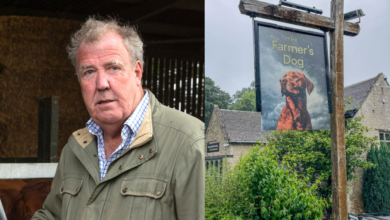
Jeremy Clarkson Reprimands Kaleb Cooper in Tense Confrontation – Is Their Partnership Over Due to Business Rivalry?
Kaleb Cooper Reprimanded by Bird Advocate During Tense Moment at Clarkson’s Farm

A light-hearted but telling dispute unfolded recently at Jeremy Clarkson’s Diddly Squat Farm in Oxfordshire, where farmhand and fan-favorite Kaleb Cooper found himself on the receiving end of a stern lecture from a local bird conservation advocate. The incident, later recounted by Clarkson in his Sunday Times Magazine column, sheds new light on the ongoing tension between agricultural realities and wildlife protection on Britain’s farmland.
Cooper, now 27, has become an unlikely celebrity since first appearing on the debut season of Amazon Prime Video’s hit series “Clarkson’s Farm” in 2021. Viewers quickly embraced his dry wit, unwavering confidence, and no-nonsense approach—qualities that often contrast humorously with Clarkson’s chaotic brand of farming. Since his introduction, Cooper has appeared in all subsequent seasons of the award-winning show, including the fourth series released earlier this year.
Outside of the public eye, Cooper leads a busy personal life. He and his partner, Taya, are now parents to three children, most recently welcoming a baby boy, Ashton, in September. But while Cooper’s family life is thriving, his work at Diddly Squat continues to place him at the center of local debates—particularly those involving wildlife conservation.
The Bird Campaigner Arrives
According to Clarkson, the latest conflict emerged when Hannah Bourne-Taylor, a local parish councillor and bird conservation campaigner, visited the farm with a proposal to monitor and support native bird populations. Bourne-Taylor, who has written and spoken widely about the decline of several UK bird species, was eager to enhance habitats on the land and expand conservation efforts.
In response to her proposal, Clarkson agreed to create wildflower strips across the central areas of his fields, an initiative designed to encourage insects and improve the overall biodiversity of the farm. But Bourne-Taylor reportedly felt more could be done. When she approached Cooper to ask whether additional measures were possible, the farmhand—known for both his honesty and stubbornness—gave a brief, blunt reply: “No.”
Clarkson, as he often does, turned the moment into a humorous anecdote. But the tension soon escalated into a more serious encounter.

A Clash Over a Cutting Schedule
The situation, according to Clarkson’s account, came to a head in early June. Bourne-Taylor arrived at the farm to find Cooper mowing one of the grass fields to prepare hay for the cattle’s winter feed. Although such mowing is standard practice for farmers, its timing can be sensitive during nesting season.
Bourne-Taylor was distressed. As Clarkson described it, she immediately approached Cooper, alarmed that the mowing could endanger baby skylarks—a ground-nesting species whose chicks remain hidden in grass nests and are often unable to fly when mowing begins.
“She was distraught,” Clarkson wrote. “She said, ‘He’s mincing all the baby skylarks. They’re in their nests in this field, and they’re too young to fly off.’”
Skylarks are a protected species in the UK, and conservation groups have long warned that agricultural cutting schedules can threaten breeding populations. The issue underscores a years-long nationwide debate: how to balance farming necessities with wildlife protection.
Kaleb’s Dilemma: Hay Now or Never
Cooper reportedly listened to Bourne-Taylor’s concerns but defended his actions as essential to the farm’s operations. According to Clarkson, Cooper argued that delaying the cut until the skylarks were old enough to escape the machinery would leave the grass too old, dry, and stalky to produce viable nutrient-rich hay for the cattle. Poor-quality hay would mean inadequate winter feed, impacting the farm’s overall sustainability.
Clarkson noted that Cooper “took his b******* like a man,” acknowledging Bourne-Taylor’s frustration while standing firm in his position. The 27-year-old farmer insisted that certain agricultural decisions must be made at the correct time, even if they appear disruptive to observers unfamiliar with the delicate balance farmers must manage.
Nonetheless, Clarkson intervened. He instructed Cooper to delay cutting the next field, allowing the skylarks more time to leave their nests.
The result? Clarkson humorously admitted that Cooper was right all along.
“When we waited and finally cut the next field, the grass was useless,” he wrote. “It had passed the ideal point entirely.”
He added, with typical Clarkson flair, that the poor nutritional quality of the delayed hay would likely have visible consequences on the herd: “Next spring our cows are going to look like they’ve been on Mounjaro,” he joked, referencing the weight-loss drug.
A Familiar Clarkson’s Farm Theme
The episode captures a recurring theme from Clarkson’s Farm: the uneasy but unavoidable intersections of modern farming, environmental expectations, and the public’s growing interest in sustainable agriculture.
The show has repeatedly highlighted similar conflicts—from hedgerow management to soil health to government regulations—often revealing how complex and imperfect real-world farming solutions can be. Cooper, despite his youth, has become the unexpected voice of practicality in these debates, regularly reminding Clarkson (and viewers) that farming requires constant compromise, careful planning, and timely execution.
A Microcosm of a National Conversation
While the incident was recounted with Clarkson’s usual humor, the underlying issue reflects broader discussions taking place across the UK. Farmers are increasingly pressured to support biodiversity initiatives while still producing reliable food supplies. Conservationists, on the other hand, emphasize that sustainable farming must not come at the expense of vulnerable species.
The disagreement between Cooper and Bourne-Taylor—though small in scale—illustrates how challenging that balance can be. It also serves as a reminder that Britain’s countryside, long romanticized, is a dynamic workplace where competing needs must be continually negotiated.
Despite the momentary tension, Clarkson’s story ultimately paints both Cooper and Bourne-Taylor as individuals passionate about their work, each advocating for what they believe is best for the land. And, true to the spirit of Clarkson’s Farm, the anecdote offers viewers another glimpse into the daily trials, pressures, and occasional theatrics of running Diddly Squat Farm.