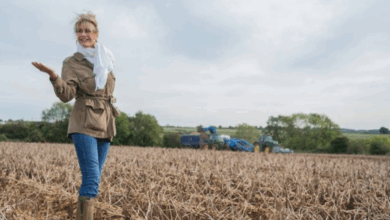
Jeremy Clarkson and Kaleb Cooper Discover ‘Half an Ear’ on Farm: What Horrible Incident Occurred at Diddly Squat?
Diddly Squat’s Darkest Moments: Clarkson and Kaleb Relive ‘Half-Ear Horror’ as TB Crisis Deepens – A Raw Look at Farming’s Brutal Reality
Jeremy Clarkson and his trusted farmhand Kaleb Cooper have never shied away from the unfiltered truth of life at Diddly Squat Farm. But in a recent Amazon Prime YouTube segment, the duo—joined by Clarkson’s partner Lisa Hogan—were forced to confront two of the most harrowing incidents in the farm’s short but turbulent history: the gruesome discovery of a piglet’s severed ear and the heart-wrenching culling of the farm’s first-ever calf due to a devastating tuberculosis (TB) outbreak. What began as a light-hearted game of “Who Said That?” quickly descended into a sobering reflection on the emotional and physical toll of modern British farming, exposing the stark contrast between the show’s viral comedy and the grim realities that unfold when the cameras stop rolling.
The ‘Half-Ear’ Incident: A Gruesome Discovery That Shocked the Team
The moment came during a promotional clip for Clarkson’s Farm Season 4, uploaded to Amazon Prime’s official YouTube channel. Clarkson, Cooper, and Hogan were playing a round of “Who Said That?”, guessing the origins of cryptic farming quotes. The phrase in question—“The only thing they won’t eat is teeth”—immediately triggered a collective shudder.
Lisa Hogan, with visible unease, recalled the incident: “Half an ear she left as well.” Clarkson, leaning into the memory with his characteristic gallows humour, clarified: “It was the very first piglet we had.” Kaleb, usually the voice of stoic pragmatism, remained silent as Clarkson continued: “If she hadn’t left half an ear, we wouldn’t have known what had happened. We’d have just thought it escaped. When you find half an ear, you know.”
The piglet in question was born during the early days of Diddly Squat’s pig-rearing experiment, introduced in Season 3 as part of Clarkson’s diversification strategy. What should have been a milestone—proof that the farm could sustain livestock beyond cattle and sheep—turned into a nightmare when the sow, a first-time mother, turned on her own offspring in a cannibalistic frenzy.

Veterinary science offers grim explanations for such behaviour. Stress, nutritional deficiencies, cramped conditions, or genetic predisposition can trigger savaging in sows, particularly gilts (first-time mothers). According to the Agriculture and Horticulture Development Board (AHDB), up to 10–15% of piglet deaths in outdoor systems can be attributed to maternal infanticide, though the majority go unnoticed—piglets simply “disappear.” At Diddly Squat, the half-ear was the only evidence: a tiny, bloodied fragment found in the straw, confirming the worst.
For Clarkson, who had already endured crop failures, council battles, and badger disputes, this was a brutal initiation into the darker side of animal husbandry. “You don’t expect it,” he later reflected in a Sunday Times column. “You think pigs are just… pigs. Then you realise they’re capable of things that make horror films look tame.”
Kaleb Cooper, now 27 and a seasoned voice in the Clarkson’s Farm narrative, has long warned about the psychological needs of livestock. In previous seasons, he lectured Clarkson on farrowing crate alternatives, space requirements, and the importance of calm environments during birth. “Pigs aren’t daft,” he’s said on camera. “They get stressed, they do mad things.” The half-ear incident validated his concerns—and served as a cautionary tale for viewers romanticising small-scale farming.
TB Tragedy: The First Calf Lost to a Relentless Outbreak
If the piglet horror was a shock, the tuberculosis crisis has been a slow-burning catastrophe. In early October 2025, Clarkson posted a sepia-toned Instagram image of a cow staring mournfully into the lens. The caption was devastating in its simplicity: “This was the first calf ever born at Diddly Squat. And this morning she was destroyed, while pregnant with twins, because she has TB. So sad.”
Born in 2020, the calf—affectionately tracked by fans as a symbol of the farm’s early successes—was due to calve again, this time with twins. Instead, she became the latest victim of a bTB outbreak that began over the summer and has since escalated into a full herd emergency.

Clarkson first raised the alarm in August, warning followers that routine testing had revealed reactors. Under Defra (Department for Environment, Food & Rural Affairs) protocol, any positive skin test triggers immediate isolation, followed by gamma interferon blood confirmation and compulsory slaughter. Compensation is provided—typically £1,000–£2,000 per animal—but it does little to offset the loss of genetics, future productivity, or emotional investment.
By late October, the outbreak had deepened. Follow-up tests identified additional infected animals, placing the entire 1,000-acre operation under movement restrictions. No cattle can leave the farm alive except for slaughter, beef sales from the farm shop are suspended, and all breeding activity is frozen. The pregnant cow’s culling was particularly cruel: not only did it end a bloodline Clarkson had nurtured from the start, but it also erased two unborn calves—three lives lost in a single morning.
Bovine TB, caused by Mycobacterium bovis, remains one of Britain’s most intractable agricultural diseases. It costs the industry over £100 million annually in testing, culling, and lost trade. Oxfordshire falls within the High Risk Area, where 10–15% of herds test positive each year. Badgers are the primary wildlife reservoir, with setts dotting Diddly Squat’s hedgerows and woodlands. Despite controversial culling programmes, transmission persists via shared grazing, contaminated water, or aerosol spread in barns.
Clarkson has been vocal about the bureaucracy. “You follow every rule,” he told The Times. “You test, you isolate, you pray. And still, they come with the bolt gun.” The emotional toll was evident in his Instagram post—rare vulnerability from a man known for bombast.
The Pig Herd Under Threat: A New Front in the TB War
While the cattle bear the brunt, the pig operation—once a beacon of hope—is now at risk. Though pigs are less susceptible to M. bovis than cattle, infection is possible, particularly in mixed farming systems like Diddly Squat. The AHDB reports rare but rising cases of swine TB in outbreak zones, often linked to environmental contamination: shared slurry pits, runoff from cattle areas, or farm workers tracking bacteria on boots and clothing.
Clarkson’s viral X post on October 27—“Today, I have rented out a pig for sexual purposes”—celebrated a £200–£500 stud fee from his prize boar. But that same mobility now poses a biosecurity nightmare. Transporting the boar to neighbouring farms risks importing infection—or exporting it if Diddly Squat is the source. Artificial insemination, while less romantic, would have been safer. Instead, natural service (with its 85–90% success rate) keeps the operation traditional—and vulnerable.
Kaleb has pushed for upgrades: separate boot dips, designated pig-only clothing, and quarantine pens for returning animals. But with filming paused—likely due to post-production or weather delays—the team is racing to implement changes before winter complicates containment.
From Chaos to Global Conversation: The Clarkson Effect
Despite the crises, Clarkson’s Farm has achieved something remarkable: it has made British agriculture a global talking point. The show, now renewed through Season 6 with a 95% Rotten Tomatoes score, has turned Diddly Squat into a pilgrimage site. Fans queue for Hawkstone lager, Kaleb bobbleheads, and photo ops with the infamous tractor.
Clarkson revealed in a recent Sunday Times column that a Chinese agricultural delegation visited the farm, inspecting everything from the high-tech hen houses (disguised as Romany caravans) to the pig pens. “They wanted to know how we do it,” he wrote. “One called me ‘incompetent’ to my face. But they still took notes.”
The delegation’s interest underscores a paradox: Clarkson, the self-confessed novice, has become an unlikely ambassador for rural Britain. His willingness to expose failure—the drowned crops, the cannibal sow, the TB cull—has humanised an industry often obscured by statistics and subsidies.
Looking Ahead: Resilience, Reform, and Season 5
As autumn rains turn fields to mud, Diddly Squat faces its toughest winter yet. Season 5, already in production, will likely chronicle the TB fallout: veterinary battles, badger debates, and the emotional aftermath of loss. Will the pig herd survive? Can Clarkson rebuild the cattle bloodline? And how will Kaleb—now a father himself—balance mentorship with his own growing fame?
The half-ear and the fallen calf are more than anecdotes. They are emblems of a broader truth: farming is not a hobby, not a TV gimmick, but a daily confrontation with life, death, and the fragile line between them. Clarkson, Cooper, and Hogan don’t just entertain—they educate, provoke, and occasionally break your heart.
In the end, the measure of Diddly Squat isn’t profit margins or viral tweets. It’s the ability to stand in a blood-stained pen, ear fragment in hand, and still plant the next seed, birth the next litter, fight the next outbreak. As Clarkson once said: “Farming isn’t about winning. It’s about not giving up.”
And as long as the cameras roll—and even when they don’t—that’s a story worth telling.